
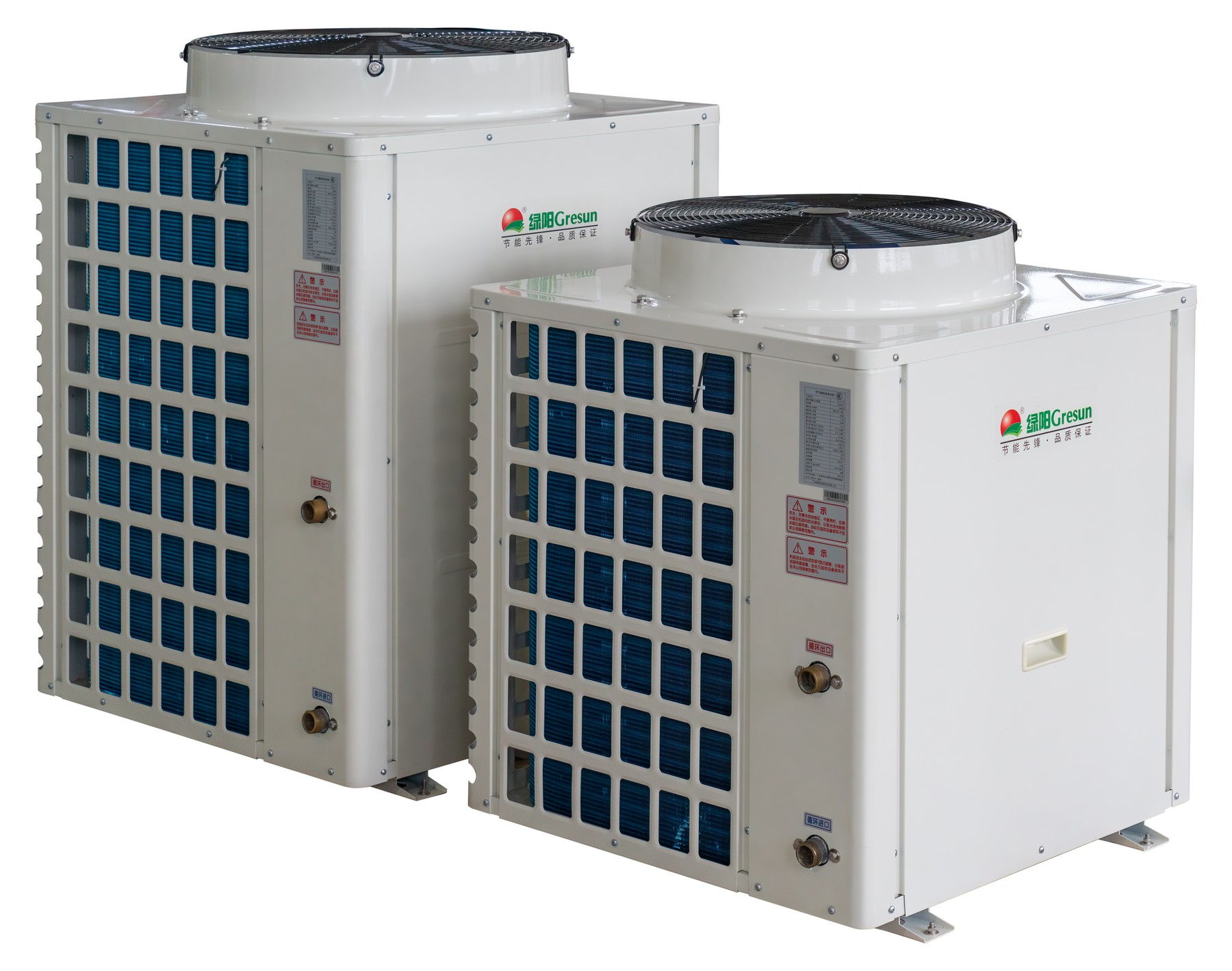
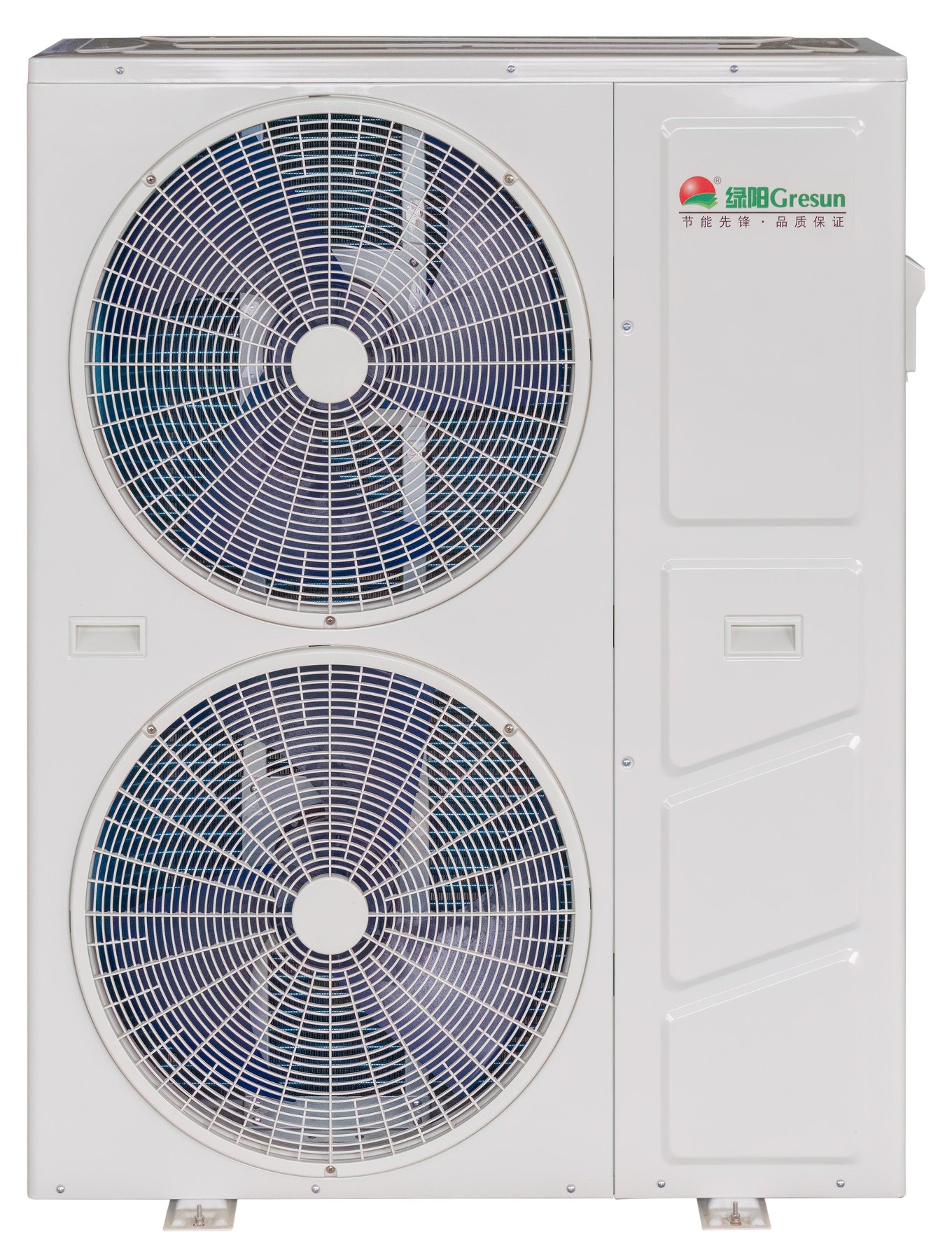
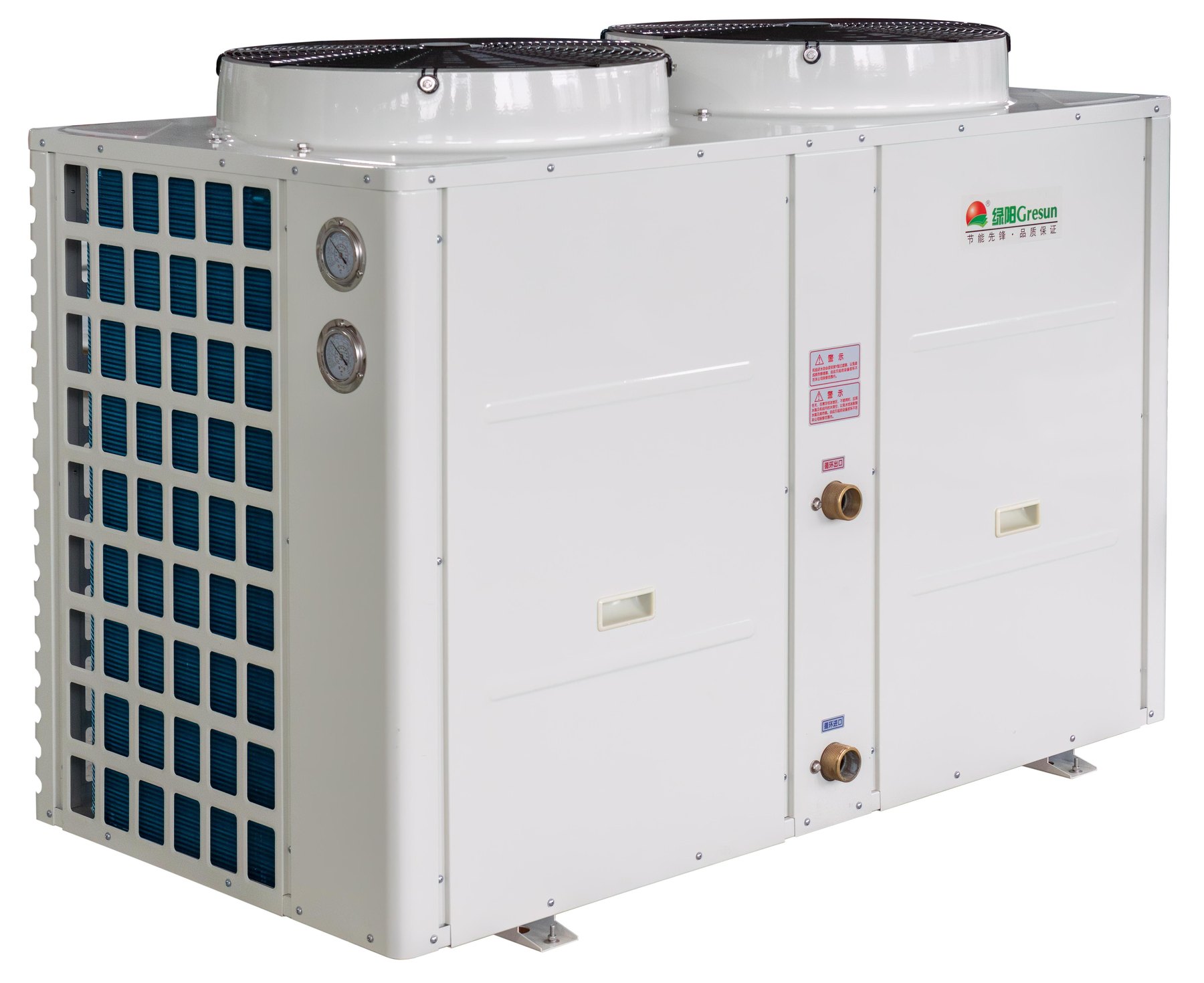
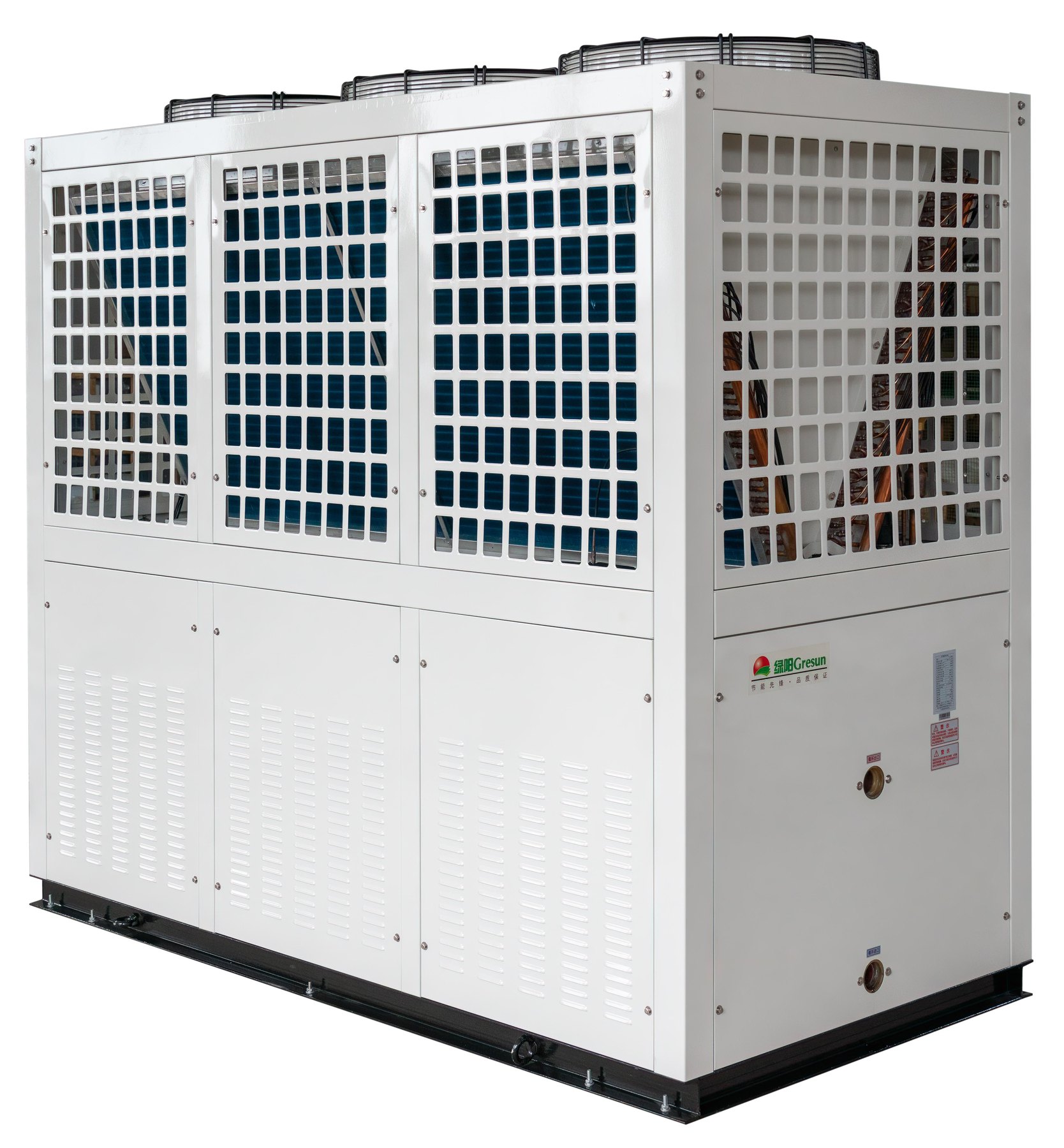
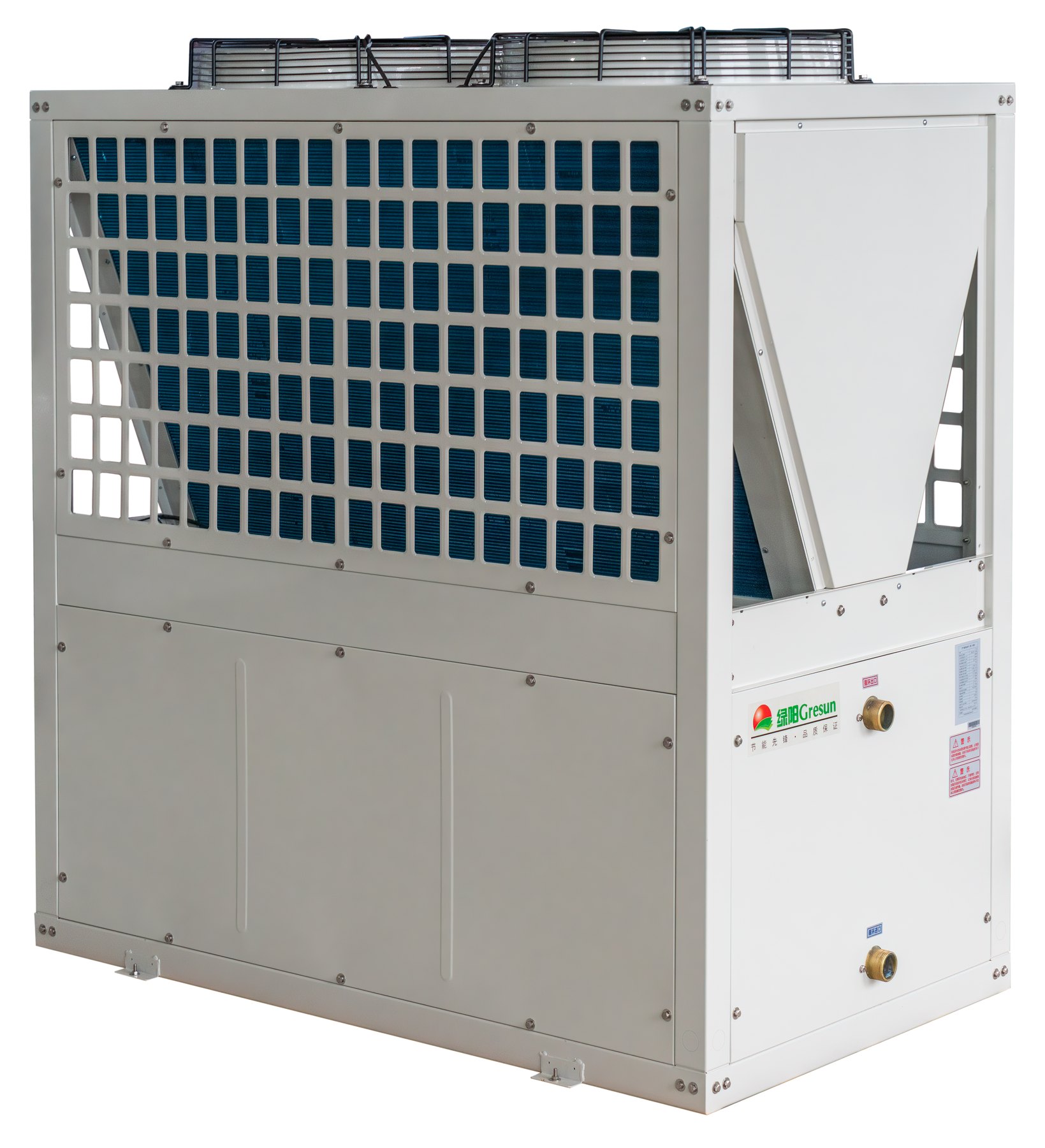
Series positioning
Sized by pool volume, water surface area and heat-up time, with titanium exchangers and corrosion control for indoor, outdoor, saltwater and spa pools.
This series sits within the air-source heat pump series. It can be combined with other series in the same product line or supplied as a standalone equipment package, with the final configuration set by load, site conditions and operating strategy.
How a pool heat pump works
A pool heat pump moves low-grade heat from outdoor air into pool water through a reversed Carnot cycle: the evaporator absorbs heat, the compressor raises pressure, a titanium-tube condenser transfers heat to the pool, and the expansion valve returns refrigerant to the evaporator. The unit holds pool water at 26–32°C, a different operating envelope from a 55–60°C domestic hot-water heat pump.
Pool water is drawn by the circulation pump through a sand filter or bag filter and into the heat exchanger; the unit starts, stops or modulates on return-water temperature and setpoint. A flow switch and differential-pressure protection prevent dry running at low flow. For indoor pools that need constant temperature and dehumidification, an integrated pool unit combines pool heating, air dehumidification and space conditioning in one package.
Models and heating capacity
| Heating capacity (kW) | Input power approx. (kW) | COP | Water flow approx. (m³/h at ΔT 4 K) | Connection | Power supply |
|---|---|---|---|---|---|
| 10 | 2.2–2.6 | 3.9–4.6 | 2.2 | DN25 | 220 V single-phase |
| 15 | 3.3–3.8 | 3.9–4.6 | 3.2 | DN25/DN32 | 220/380 V |
| 20 | 4.3–5.0 | 3.9–4.6 | 4.3 | DN32 | 380 V three-phase |
| 25 | 5.4–6.2 | 3.9–4.6 | 5.4 | DN32/DN40 | 380 V three-phase |
| 30 | 6.4–7.5 | 3.9–4.6 | 6.4 | DN40 | 380 V three-phase |
| 40 | 8.6–10.0 | 3.9–4.6 | 8.6 | DN40/DN50 | 380 V three-phase |
| 50 | 10.8–12.5 | 3.9–4.6 | 10.8 | DN50 | 380 V three-phase |
| 60 | 12.9–15.0 | 3.9–4.6 | 12.9 | DN50/DN65 | 380 V three-phase |
Nominal capacity is not winter capacity. Ask for the low-ambient capacity at the local winter design temperature and deduct defrost loss; sizing on the nominal figure alone will undersize the unit.
Sizing: two load calculations plus a winter check
The first calculation is the heat loss at the target pool temperature: surface evaporation, convection and radiation, wall conduction, make-up water heating and pipe losses. Indoor surface evaporation is typically 100–200 W/m² and outdoor 200–350 W/m²; take the upper end for an uncovered pool with high wind and low humidity.
The second calculation is initial heat-up: Q = VρcΔT/(3600t). For 500 m³ with a 12 K rise in 48 h, net heat is about 145 kW, and about 170 kW with margin; for 1,000 m³ with a 15 K rise in 48 h, about 364 kW net and about 430 kW with margin.
Design load Q = (heat loss + make-up load) × 1.1–1.2; unit count N = Q / unit capacity, rounded up and rechecked against winter capacity. Do not size a pool from a single kW-per-m³ factor: a 500 m³ indoor pool and a 500 m³ outdoor resort pool can differ by a factor of three in heat loss.
| Pool volume (m³) | Temperature rise (K) | Time (h) | Net heat (kW) | Suggested capacity (kW) |
|---|---|---|---|---|
| 200 | 12 | 48 | 58 | 70 |
| 500 | 12 | 48 | 145 | 170 |
| 500 | 12 | 72 | 97 | 115 |
| 1000 | 12 | 72 | 194 | 230 |
| 1000 | 15 | 48 | 364 | 430 |
Formal selection should follow CJJ 122-2017 Technical specification for swimming pool water supply and drainage engineering, local requirements and a selection document issued by the designer or manufacturer.
Water quality and corrosion control
- Use a titanium-tube exchanger for chlorinated, saltwater and seawater pools; copper is not recommended even for fresh water.
- Coils, casings and fasteners must suit a damp chloride environment; use 316L bolts and avoid exposed carbon steel.
- Run pool water at pH 7.2–7.8 and free chlorine 1–3 mg/L; keep dosing points away from the unit inlet so concentrated chemicals are not drawn in.
- Size the filter on the turnover period and fit filtration ahead of the exchanger; low flow triggers the protection device and accelerates scaling.
Installation and commissioning
- Prevent air short-circuiting between inlet and discharge; leave clear space above top-discharge units, and provide exhaust or ducting for indoor plant rooms.
- Size the piping for the rated flow and a 4–5 K design temperature difference; add a hydraulic bypass where the pool pump flow exceeds the unit rated flow.
- Install a flow switch or differential-pressure switch, freeze protection and filter pressure monitoring; drain down or keep circulation running in winter.
- Provide 220 V single-phase or 380 V three-phase supply with residual-current protection and reliable grounding; rotate lead/lag and stagger starts on multiple units.
- Record entering and leaving water temperatures, flow, pressure drop, current, high-side and low-side pressures and defrost state as the commissioning baseline.
Applications
- Hotel and resort pools
- School, club and sports center pools
- Villas, communities and spa pools
- Indoor pools needing dehumidification
System components
- Pool heat pump with titanium-tube heat exchanger
- Circulation pump, filter, valves and piping
- Compatible disinfection or chemical dosing system
- Flow switch, freeze protection and controls
- Indoor pools: dehumidification or integrated pool module
Information needed for selection
- Pool volume, water surface area, design temperature and make-up rate
- Indoor or outdoor, cover, wind exposure and winter design temperature
- Circulation flow, filtration and disinfection (chlorine, salt or ozone)
- Plant room or air-side space, power supply and noise limits
Frequently asked questions
What is the difference between a pool heat pump and a domestic heat pump water heater?
A domestic hot-water unit delivers water at 55–60°C and uses an exchanger designed for potable hot water. A pool heat pump delivers water at 26–32°C, uses a titanium or chlorine-resistant exchanger, runs at higher flow and a smaller temperature difference, and is protected against chlorine, salt and pH. The two are not interchangeable.
How much capacity does a 1,000 m³ indoor pool need?
Volume alone is not enough. Calculate the heat loss from surface evaporation, convection and radiation, wall conduction, make-up water and pipe losses, then check initial heat-up. For 1,000 m³ with a 15 K rise in 48 h, net heat is about 364 kW; allow about 430 kW with margin. Confirm against surface area, indoor humidity and make-up rate.
Can an outdoor pool heat pump run in winter?
Yes, but use the low-ambient capacity at the local winter design temperature and deduct defrost loss; never size on nominal capacity. Outdoor pools without a cover and with high wind lose much more heat, so add an insulating cover, shorten shutdown periods and allow a backup heat source.
Is a titanium heat exchanger necessary?
Titanium or an equivalent chlorine-resistant material is recommended for chlorinated, saltwater and seawater pools; copper is not suitable even for fresh water. Titanium resists chloride attack and mild pH swings, but welds, flanges and fasteners still need 316L stainless steel or equivalent corrosion protection.
Can one unit heat the pool and dehumidify the room at the same time?
Yes. An integrated pool unit combines pool-water heating, air dehumidification and space conditioning for indoor pools and hotel pools. Size it on indoor moisture load, occupancy and fresh-air conditions, not on pool-water load alone.
Why does the unit short-cycle or trip on high pressure?
Check water flow and filter pressure drop first, then air recirculation, dirty coils, an excessively high setpoint and refrigerant charge. Pool water is cool, so high pressure usually points to insufficient water flow or poor heat rejection, not normal operation.
How should a saltwater or seawater pool be specified?
Choose a titanium exchanger, corrosion-protected coils and 316L fasteners; keep the unit away from the salt feed point so concentrated brine is not drawn in; rinse the exchanger after shutdown and check ORP probes and free chlorine regularly, keeping them within the water-quality limits published by the manufacturer.
What must be replaced when retrofitting an existing pool?
Verify that the circulation pump, filter, valves and piping can deliver the heat pump rated flow; add flow interlock and freeze protection; check electrical capacity and grounding; keep the existing disinfection system only if its materials are compatible. Do the hydraulic calculation before replacing just the unit.
Inquiry and delivery
Share the site, pool volume and surface area, design water temperature, indoor or outdoor operation, disinfection method, winter design temperature and timeline. We will confirm the system boundary first, then propose the series configuration, equipment scope and next data requirements.